How should actuators be selected for metal processing?
Selection starts with the required force, stroke, cycle, mounting arrangement and environmental exposure. Share these conditions so a suitable product family can be proposed.
Application area
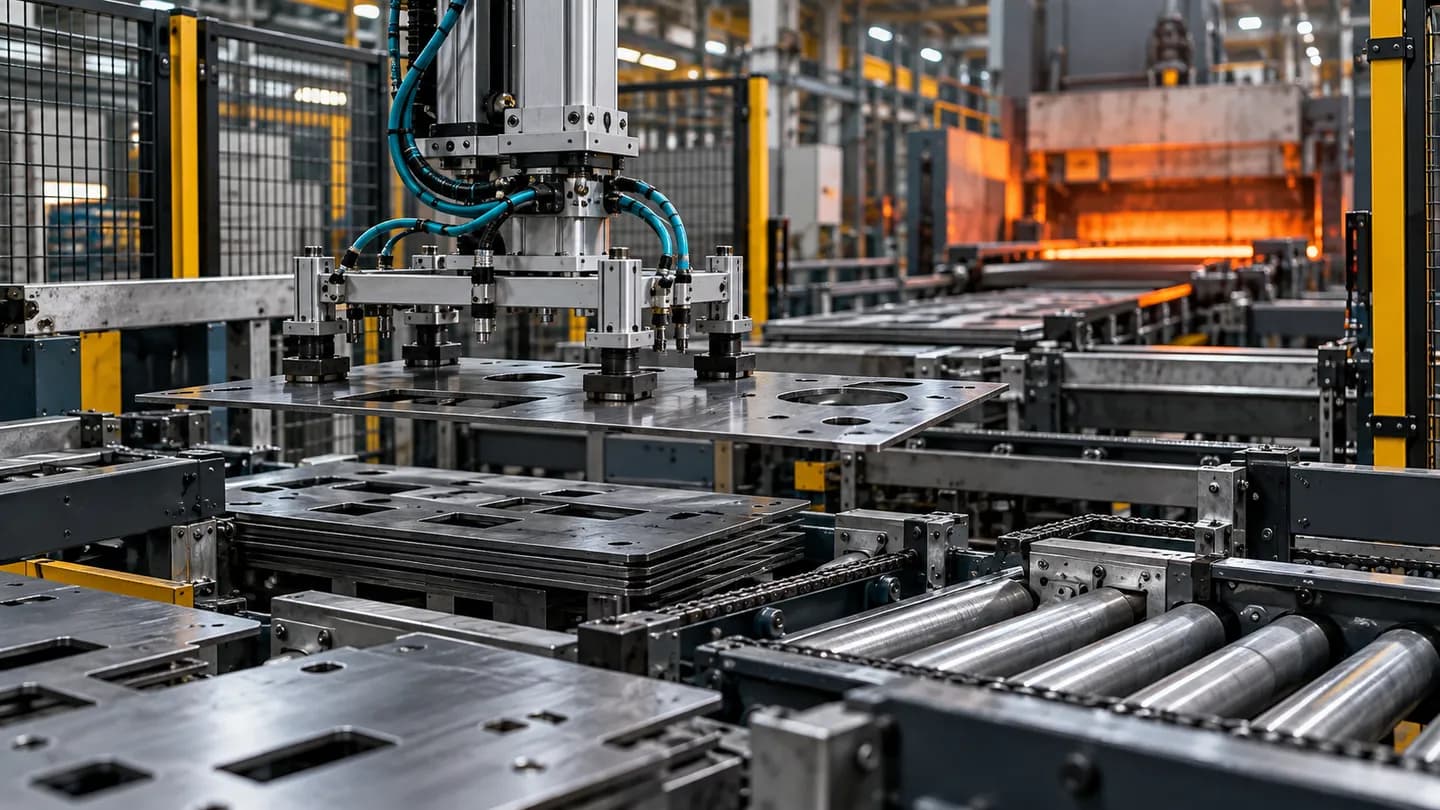
Metal-processing equipment often requires robust clamping, transfer and fixture motion around dust, scale or temperature variation. Pneumatic components can be selected around the actual force, cycle and environmental conditions.
Where pneumatic motion fits
These are common examples, not a substitute for application-specific engineering review.
Sheet, plate and formed-part transfer
Fixture clamping and locating
Machine tending and part separation
Roller-line and process-equipment actuation
Selection checklist
Start with these families
Product family
Parallel, angular, wide-opening and compact gripping options for automated handling.
Browse products →Product family
Linear motion for clamping, stopping, lifting, positioning and transfer movements.
Browse products →Product family
Control pneumatic actuator sequences, valve islands and distributed machine functions.
Browse products →Product family
Filter, regulate and prepare compressed air for stable machine operation.
Browse products →Application note
For regulated, wash-down, high-temperature, high-contamination or safety-critical environments, please confirm material compatibility, required certification and installation conditions with our team before purchase.
FAQ
Selection starts with the required force, stroke, cycle, mounting arrangement and environmental exposure. Share these conditions so a suitable product family can be proposed.
Many applications are possible, but jaw design, contact surface, edges, weight and any hot or oily condition must be evaluated for the actual part.
Satış mühendisliği
Include the part or drawing, motion, pressure, cycle rate and quantity whenever possible.